We have landed

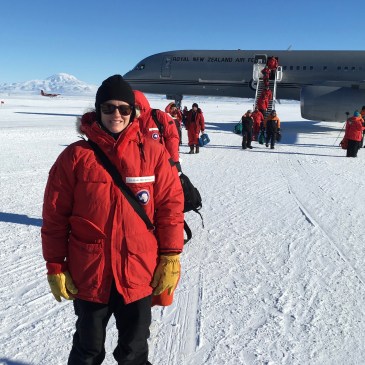
The last several days have felt much longer than a week. A lot has happened. I packed my bags and then made the long haul to Christchurch, New Zealand. There I was issued my ECW (Extreme Cold Weather) gear at the CDC (Clothing Distribution Center) before the final deployment by the US Antarctic Program. If you are heading to McMurdo from the U.S., then you traveled the same path as everyone else. Your flight agenda took you from Los Angeles, CA, to Auckland, New Zealand, to Christchurch, New Zealand, to McMurdo Station, Antarctica. We left the 16th from Santa Barbara and arrived to McMurdo on the 20th for an arrival briefing at the Chalet. We are officially here.

Antarctica is one of the coldest and most remote places, and it is incredible to be here. I snapped a few in-flight photos of my first views of this beautiful continent. Our flight path took us across northern Victoria Land, the region of my current research focused on the petrochronology and geochemistry of Ross Orogen magmatism. Right away you can see how challenging this environment is for field studies, with the majority of all surface area covered in snow and ice. We were lucky enough to make the four-hour flight via Boeing 757 operated by the Royal New Zealand Air Force. Christchurch to McMurdo is approximately 4,000 kilometers. That is a similar distance to the entire length of the Transantarctic Mountains.

Since arriving, my days have been full of safety trainings, briefings for all field equipment and operations, and triple checking of our RSP (Research Support Plan). The RSP includes every aspect of logistics for our field season, from air support to scientific services to equipment and food allocations. It is incredible to know that there is an entire base at McMurdo to enable the research that will come from our sample collection. Each year NSF funds approximately 50 scientific projects on Antarctica. These highly collaborative projects are tasked to expand the fundamental knowledge of the region as well as undertake projects reliant on unique characteristics specific to the Antarctic continent. From my brief observations, this translates to an incredibly organized community of highly intelligent and motivated individuals ranging across both the staff and research grantees. This is truly an incredibly opportunity that I am fortunate to be a part of.

Antarctica360.net – UCSB Geologists on ice

Antarctica, the time is now

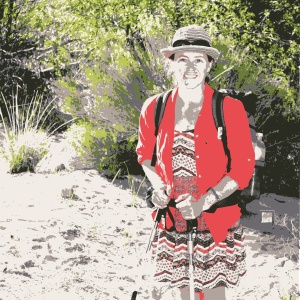
This is late in coming, but something I am checking off my To Do list all the same. In 48 hours I will depart for Antarctica. That sentence alone sums up the crazed state of my last few weeks. I finished the Pacific Crest Trail, survived my Ph.D. program’s comprehensive exams to remain in graduate school, and now I depart for field work in Antarctica. I have had many awesome experiences in my lifetime, but this one is truly special. On October 20th, 2016, I will depart from Christchurch, New Zealand, and arrive at McMurdo Station, a research center on the south tip of the Ross Island at the edge of the ice shelf. I will be accompanied by my advisor, Dr. John Cottle (you can check out his research here: LINK), and my fellow lab mate, Demian Nelson (you can check out his research here: LINK). You can follow our adventures at antarctica360.net. I will try to also post updates here, but likely they will mirror the ones posted to the research blog.

We will spend a short time at McMurdo and then will be in the field for approximately six to eight weeks, all but cut off from the living world. We will have a satellite phone to create a hot spot to send out messages, but there will not be any incoming calls or internet. More serious than that will be that this is my first experience with no gray water for a prolonged period of time. Everything is brought in, and everything is packed out. That means no laundry, no showers, no face rinsing, collecting all urine in a bottle and all feces in a bucket. Nothing is dumped on the ground.

The logistics go beyond this though. We are targeting two main areas to collect rock samples, and both are within 7 degrees of the South Pole. This means that I will not be at a station, but camping on ice. My mode of travel will be on foot and by skidoo. Our mission will be to collect rock samples from the exposed Transantarctic Mountains. As amazing and exciting as this trip will be, safety will also be an important aspect. With average temperatures between -30 and -40 degrees Celsius (this is summer time!), deep, hidden crevasses littering the glacier covered terrain, and high potential for rapid, extreme weather changes, life threatening dangers will be everywhere.

But that is what lures me to this field work. During undergrad, I spent a month in northern Minnesota tracking wolves. That was my first experience with winter survival. Not to mention that I lived in Iowa, so tree-snapping ice storms are the norm. I haven’t turned back since. Two winters in Colorado resulted in about 80 total ski days and numerous winter excursions. I also completed the AIARE 1 for decision making in backcountry avalanche terrain. Had I not moved to California, I would have spent last winter knee-deep in snow pursuing my interest in backcountry skiing. I will not claim some expertise for an Antarctic adventure, but I do know that I am beyond excited and ready for whatever comes my way.

Stay tuned and I will try to create an agenda so you know what to expect on this adventure of a lifetime!