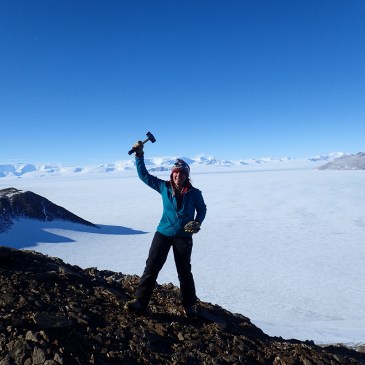
The weather is fierce

11/10/2016

I have not been keeping a journal. My apologies. I am going to go with it being due to the cold and wind that seem to control much of my routine each day.

Yesterday we stayed at camp. The winds are blowing hard. There was steady at mid-30 knot wind speeds with gusts up to 40 knots. For those who do not know. A knot is a unit of speed common to boat travel (and for some reason Antarctic weather forecasting) equal to one nautical mile (1.852 km) per hour, or approximately 1.151 miles per hour. At McMurdo, there are three weather conditions, and the only only that allows foot travel is Condition III. This is the safest weather, whereas Conditions II and I require special permission for protected transport or no transport at all (respectively). The definition of Condition III weather is: visibility greater than a 1/4 mile, air temperature and wind chill above -75 degrees Fahrenheit, and wind speeds less than 48 knots (that is 55 mph). To reiterate, this describes “good” weather. Ha! For today, you can think of us driving around skidoos in 35+ mph winds. Not that fun, but also not beyond the danger level. For those not very experienced in windy weather, let me give you some perspective. Hurricanes must have maximum sustained winds of at least 74 mph (>64 knots). A tropical storm  has winds in the 39-73 mph range (34-63 knots), and a tropical depression has wind speeds less than 38 mph (<33 knots). Hurricanes (northern hemisphere storms) are ranked using the Saffir-Simpson hurricane wind scale, ranging from category one through five for winds speeds starting at 74 mph (64 knots) and the last category denoting winds greater than 157 mph (137 knots). Tornadoes use the Enhanced Fujita scale, ranking tornado intensity. The lowest damage category ranges from 65-85 mph (56-74 knots) and the highest category denotes wind speeds greater than 200 mph (174 knots).

Today the winds are still blowing powerfully at low 30 knot speeds, but we went out anyways. It was fairly miserable, but science cannot be stopped. And we cannot really afford to let some wind prevent us from utilizing this time to finish the field work. Two days ago I woke up early to start going through the samples to bag and box them up in the wooden rock boxes for travel back to Santa Barbara. After these two days of blowing snow, the samples are all buried. Hopefully we can find them all. Fortunately I set them out numerically in rows, so it shouldn’t be too difficult to figure out. The toilet tent has been reduced to violently flapping tethers of shredded tent material. The wind very effectively destroyed that tent with little effort. Hopefully the winds stop soon. The number of camp chores are growing and none will be fun with this wind. To top it off, on the return ride to camp, Demian’s and my bags fell off the sled. John found them back at the south side of the moraine arm we cross heading north away from Ascent Glacier.

Miller Range

11/4/2016

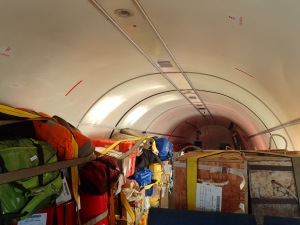
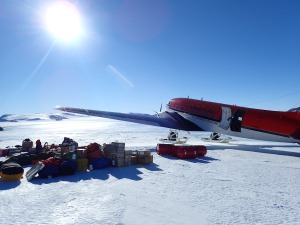
This morning we loaded into a Basler BT-67 (Turbine DC-3) aircraft and flew to Miller Range. Our official camp name is Ascent Glacier. We have made it. From now on we will travel by skidoo. We will try to access as many outcrops as possible in pursuit of lamprophyre.

We had beautiful weather for camp put-in. Calm, blue sunny sky, and relatively warm temperatures. They taxied right to where we threw out our gear and starting setting up camp. I almost thought the flight team were about to stick around and watch us dig tent plots. But off they went and on we continued to build camp.

Tomorrow we will head out to begin our rock hunt.

OLYMPUS DIGITAL CAMERA

OLYMPUS DIGITAL CAMERA

Trained up and headed for a glacier

Field work in Antarctica is different than other types of field work. The day-to-day will be focused around finding as many outcrops as possible to hammer and chisel off rocks. That is mostly true of any geology field work. The kicker is that one does not simply just go to the field in Antarctica. Beyond the logistics, costs, and getting to the continent, there are numerous pre-field trainings. These trainings range from understanding the rules of the Antarctic Conservation Act to extreme cold weather awareness, from camping on snow to glacier travel and crevasse rescue training, and from lab facility safety to snow machine training and repair instruction. We will be a team of three in the deep field. This means we are responsible for our own gear and mechanical troubleshooting, rock carrying, and camp maintenance. These trainings and preparations have kept us busy the past two weeks.

But all work and no play would make for an incredibly dull time while stuck in McMurdo before the science happens. So I have found some time to explore the variety of activities available at McMurdo. I went to a science talk on the sea spiders found by dive teams off the coast at McMurdo (living creature below). I joined a few new friends to climb down Obs Tube, a viewing tube about 15 feet below the sea ice. I even saw a seal! Demian and I went on a few runs to check out the views. First we ran up Observation Hill, which overlooks McMurdo Station. On a less than favorable windchill day, we ran to Discovery Hut (built by Robert Falcon Scott on the 1901-1904 Discovery Expedition) and then continued up the coast ridge for great views of where the sea ice has cracked up around the point. There was a big Halloween gathering with a costume contest and dance party. Late that night, I caught a rare view of the sun at the horizon. Summertime here means 24-hour daylight. On a blistery and miserable day, I joined two McMurdo “locals” on their day off to cross-country ski the loop to Castle Rock. The wind was so brutal that it blew all the snow off the trail and we were being pushed all over blue ice. We made a slow scurry up the first two miles where a red hut awaited to provide shelter. We realized how miserable a continued effort would be, so we turned back. But we still prevailed in defying the hard winds from ruining the one day off everyone gets each week.

John, Demian, and I had a three day combined training for glacier travel, crevasse rescue, snow camping, and basic winter skills. Ascending a rope using only Prusik knots is a feat. We loaded up into a massive Delta, headed out to the ice shelf, where we spent a whole day setting up a camp that we then tore down the next day. It was a lot of work to simply sleep out in the cold. The next day we packed up and headed to a crevasse simulator to practice skills with ice axe use, ascending a rope while in full winter gear (using both Prusik knots and ascenders), self- and team-arrest, setting snow anchors, best crampon practices, and 3-person crevasse rescue. The best part was when we simulated John falling into a crevasse (i.e., he jumped off the snow ledge), and Demian and I had to arrest his fall, rig up a pulley system to tow him out, and then actually pull him out of the crevasse. It was pretty awesome! Tonight I went over to New Zealand’s Scott Base. Thursday night is American Night, where McMurdo people are allowed to visit the base (Their gift shop is by far superior in the souvenir department!).

Now we should be all ready to get out to the field. We leave first thing in the morning. So this very well may be my last post for a bit.

Below are several photos from these trainings and adventures.

We have landed

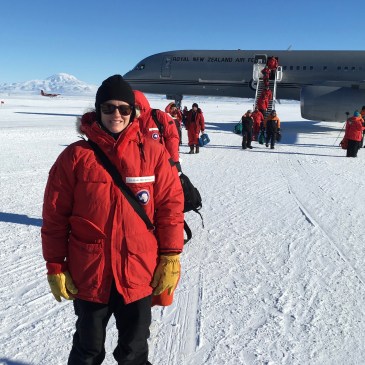
The last several days have felt much longer than a week. A lot has happened. I packed my bags and then made the long haul to Christchurch, New Zealand. There I was issued my ECW (Extreme Cold Weather) gear at the CDC (Clothing Distribution Center) before the final deployment by the US Antarctic Program. If you are heading to McMurdo from the U.S., then you traveled the same path as everyone else. Your flight agenda took you from Los Angeles, CA, to Auckland, New Zealand, to Christchurch, New Zealand, to McMurdo Station, Antarctica. We left the 16th from Santa Barbara and arrived to McMurdo on the 20th for an arrival briefing at the Chalet. We are officially here.

Antarctica is one of the coldest and most remote places, and it is incredible to be here. I snapped a few in-flight photos of my first views of this beautiful continent. Our flight path took us across northern Victoria Land, the region of my current research focused on the petrochronology and geochemistry of Ross Orogen magmatism. Right away you can see how challenging this environment is for field studies, with the majority of all surface area covered in snow and ice. We were lucky enough to make the four-hour flight via Boeing 757 operated by the Royal New Zealand Air Force. Christchurch to McMurdo is approximately 4,000 kilometers. That is a similar distance to the entire length of the Transantarctic Mountains.

Since arriving, my days have been full of safety trainings, briefings for all field equipment and operations, and triple checking of our RSP (Research Support Plan). The RSP includes every aspect of logistics for our field season, from air support to scientific services to equipment and food allocations. It is incredible to know that there is an entire base at McMurdo to enable the research that will come from our sample collection. Each year NSF funds approximately 50 scientific projects on Antarctica. These highly collaborative projects are tasked to expand the fundamental knowledge of the region as well as undertake projects reliant on unique characteristics specific to the Antarctic continent. From my brief observations, this translates to an incredibly organized community of highly intelligent and motivated individuals ranging across both the staff and research grantees. This is truly an incredibly opportunity that I am fortunate to be a part of.

Antarctica360.net – UCSB Geologists on ice

Antarctica, the time is now

This is late in coming, but something I am checking off my To Do list all the same. In 48 hours I will depart for Antarctica. That sentence alone sums up the crazed state of my last few weeks. I finished the Pacific Crest Trail, survived my Ph.D. program’s comprehensive exams to remain in graduate school, and now I depart for field work in Antarctica. I have had many awesome experiences in my lifetime, but this one is truly special. On October 20th, 2016, I will depart from Christchurch, New Zealand, and arrive at McMurdo Station, a research center on the south tip of the Ross Island at the edge of the ice shelf. I will be accompanied by my advisor, Dr. John Cottle (you can check out his research here: LINK), and my fellow lab mate, Demian Nelson (you can check out his research here: LINK). You can follow our adventures at antarctica360.net. I will try to also post updates here, but likely they will mirror the ones posted to the research blog.

We will spend a short time at McMurdo and then will be in the field for approximately six to eight weeks, all but cut off from the living world. We will have a satellite phone to create a hot spot to send out messages, but there will not be any incoming calls or internet. More serious than that will be that this is my first experience with no gray water for a prolonged period of time. Everything is brought in, and everything is packed out. That means no laundry, no showers, no face rinsing, collecting all urine in a bottle and all feces in a bucket. Nothing is dumped on the ground.

The logistics go beyond this though. We are targeting two main areas to collect rock samples, and both are within 7 degrees of the South Pole. This means that I will not be at a station, but camping on ice. My mode of travel will be on foot and by skidoo. Our mission will be to collect rock samples from the exposed Transantarctic Mountains. As amazing and exciting as this trip will be, safety will also be an important aspect. With average temperatures between -30 and -40 degrees Celsius (this is summer time!), deep, hidden crevasses littering the glacier covered terrain, and high potential for rapid, extreme weather changes, life threatening dangers will be everywhere.

But that is what lures me to this field work. During undergrad, I spent a month in northern Minnesota tracking wolves. That was my first experience with winter survival. Not to mention that I lived in Iowa, so tree-snapping ice storms are the norm. I haven’t turned back since. Two winters in Colorado resulted in about 80 total ski days and numerous winter excursions. I also completed the AIARE 1 for decision making in backcountry avalanche terrain. Had I not moved to California, I would have spent last winter knee-deep in snow pursuing my interest in backcountry skiing. I will not claim some expertise for an Antarctic adventure, but I do know that I am beyond excited and ready for whatever comes my way.

Stay tuned and I will try to create an agenda so you know what to expect on this adventure of a lifetime!

End of the trail (mile 2650.4-2658.9)

Day Ten
6 September 2016
Mile 2650.4-2658.9
Day total 8.6
Tally 197.4 miles
Total up/down: +1570/-1875ft
Camp: resort lodge floor and bus to Vancouver
LL: 49.062823, -120.782672

The end of the trail.

I don’t know what that entirely means to me yet. It is hard to put into one sentence the experience of 2658.9 miles and four months of hiking across two summers. These emotions are made more complicated by the suddenness of the trail ending last summer due to forest fires. I am sure I did a better job of conveying those emotions last summer when I was fresh from the trail. This reflection is more about feeling closure with the trail.

I can remember individual days with astounding accuracy from last summer, but I probably cannot tell you what I was doing or who I talked with three weeks ago. But then I feel like in general I can recall details from my other adventures with a higher level of accuracy than I could for the non-adventuring days. To some degree I suspect that relates to my journal-keeping habits for trips that I do not practice in between. But there is also something deeper. I think it has to do with my level of presence during adventures, and the lack there of during the day-to-day rat race. Some might call this mindfulness.

I am definitely guilty of multitasking to the detriment of whatever activity or whosever company I am trying to “enjoy.” I will be the first to admit that I revel in staying busy. That is where I feel most efficient. And anyone who has spent much time with me, even while traveling, will tell you that I have a skill at finding tasks to check off a list. That is just who I am; a list maker. My brain is a chaotic maze of thoughts bursting simultaneously like rice crispies poured onto milk. If I don’t scoop them up right away they become soggy with disinterest and sink to the bottom. This is not to say I am a compulsive person. In fact I tend to think through my actions with exhausting precision. That is how I have found myself feeling in somewhat frozen in motion from having not finished the PCT in 2015.

When I set out from the Mexican border to hike the Pacific Crest Trail, I knew I would not stop until I reached Canada. I knew that with such intensity and focus that it never crossed my mind to question its validity. For 2461.6 miles, that goal was my reality. What I did not anticipate was a fire season so bad that several brave firefighters would lose their lives and almost 200 miles of trail would be closed. So on 21 August 2015, my hike was over. I went to Monument 78 at the northern terminus with my hiking companions at the time. I needed that moment to see what I had been pushing for all summer. I also knew that I would not be satisfied if I did not go back to finish.

That closure finally came yesterday, when I arrived at the monument again, about one year later, but this time on foot via the trail. And now it’s all over again. My emotions not yet organized. I feel incredible relief to be done with sadness that it is over, unexplainable gratitude to all the people who helped me along the way, deep love for this amazing trail and the people now in my life from it, humility for accepting my accomplishments while seeing the greater deeds done by others far more generous and adventurous than me, and growing joy that I have more adventures to come.

This trail is over. I hope to someday hike it again, but that will be a new trail. The trail is constantly changing as nature changes, but I too am constantly changing. This experience will always be mine, and from it I will see every future experience in a different light. The best gift is that I know I have accomplished what I set out to do, and now I can move forward, back into motion.

Day nine (mile 2625.3-2650.4)

Day Nine
5 September 2016
Mile 2625.3-2650.4
Day total 25.1
Tally 188.8 miles
Total up/down: +4270/-6530ft
Camp: Castle Creek passed Monument 78
LL: 49.000288, -120.802120

Today we reached Monument 78, the official US-Canadian border marker.  At the border, the rainy clouds in Washington stopped right at the peak along the clear cut marking the border. Canada was sunny and warm compared to the cold, wet and windy Washington we left behind. The moment was surreal. The old monument has been sealed closed since last year, and the trail register was simply sitting out in a dry bag. We have no idea why it was sealed. Though we also found a grocery bag filled with weed, and that reminded us that last year there was also a lot of weed stashed in the monument with the completion register. I can easily imagine the monument being sealed to prevent the storage of illegal drugs. Technically weed is legal in both Washington and BC, Canada. However it is not legal to cross the border with it. Regardless, it feels really strange to officially be here, to have completed the trail on foot as I intended last summer. It is a strange thing to actually be finished now.

Today we met a woman named Cougar. She started the PCT last year too. She caught back up to us at the northern terminus and we all shared the moment of being partial PCT 2015’ers and 2016’ers. Cougar had a longer distance than us this year, but I can still understand having the end of the trail looming over like dark cloud until this glorious moment of true completion. Something really incredible about our encounter with Cougar is that she had a copy of Seawolf by Jack London that she picked up in White Pass. Last summer we were all reading Seawolf together on trail and had found it in book form at White Pass. It could be the same one!

Overall today was a relatively easy last day, despite the abundance of downhill miles. It was also a beautiful day! And we saw numerous falcons soaring the valleys. After our terminus party part two, we walked to the camp 3/10 mile further. We found a guy named Brandon with a big fire and a friendly dog named Maya. Brandon was an interesting guy, but it was the first night in a while where I went to bed completely dry and warm!

I am thoroughly exhausted and ready for a good night’s sleep.

Day eight (mile 2598.4-2625.3)

Day Eight
4 September 2016
Mile 2598.4-2625.3
Day total 26.9
Tally 163.7 miles
Total up/down: +5159/-4882ft
Camp: below Tamarack Peak
LL: 48.776890, -120.721379

We had trail magic today!! A PCT’er from this year, Walking Home, or Richard, had to get off in Northern California for an injury. He is from around here, so brought the best foods to deal out a little magic. I ate hot split pea soup, two turkey and salad wraps, strawberries, and marionberry jam on bread. The most welcome of surprises! And our last opportunity for trail magic.

Today has been our longest day; not by much, but true nonetheless. It was a formidable day as well. We climbed six different passes: Methow, Glacier, Grasshopper, Harts, Buffalo, and Windy Passes. About 3500 feet of the 5200 total feet all before lunch. All morning we hiked along a narrow patch of sun with visible rain to either side of us. Leaving lunch we had cold rainy spittle that turned into freezing grapple for the last three miles to Harts Pass. Walking Home was positioned at Harts Pass. I am so thankful for his kindness! My legs were definitely tired today. But mostly I think it was the cold that wore me out. I will sleep well tonight.

Tonight will be just as cold as last night. Icy tents by morning. We are all huddled in our fart sacks. Endless reading another Jack London short. Tomorrow we will arrive at the monument. Everything is coming to a close so quickly.

Day seven (mile 2574.3-2598.4)

Day Seven
3 September 2016
Mile 2574.3-2598.4
Day total 24.1
Tally 136.8 miles
Total up/down: +6815/-2674ft
Camp: camp below Methow Pass
LL: 48.585618, -120.720115

Today we crushed the trail. Last night was the first really cold night so I woke up to pee several times. But I felt good. My feet are feeling the beating of being weighed down with a pack (even light as it is) and my back is finally rubbing raw from my pack, but my legs feel great. I would say we averaged 3 miles per hour all day. Granted it was cold all morning and rained on us for 5 miles up a 2000 foot climb after lunch, so we weren’t dilly dallying around or anything. And we scored a local Washington IPL beer from some trail magic! Tami and I split it at lunch, where we stopped at the Rainy Pass trailhead. The sun came out and it was glorious. Two PCTA people were fixing a sign and two Forest Service people were checking the trailhead garbage and bathrooms. All of them were incredibly friendly and encouraging. The permit register showed eight Canada goers through this morning, and at least six from yesterday. We may run into a bubble for the end. We ran into Easy several times, and I hope we see him at the monument. He is hilarious. Anyways, we arrived to our campsite just after 5PM, despite the weather and 6800 feet of climbing, including two passes. The sun was finally out temporarily as we put up tents and the temperature dropped to freezing. Tonight is extremely cold!

Day six (mile 2564.3-2574.3)

Day Six
2 September 2016
Mile 2564.3-2574.3
Day total 10
Tally 112.7 miles
Total up/down: +1950/-2056ft
Camp: Bridge Creek Camp
LL: 48.429472, -120.868353

A couple days ago we were told by a thru-hiker that there is this town named Stehekin before the border that has the best bakery. This is the sort of thing that eats away at me as a now section hiker. Of course we know about Stehekin, the last town stop before finishing the trail. I asked him if he had been there, thinking he would know if there would be cookies, my favorite food group. He response was that he has not been there before. Who gives former PCT thru hikers such ridiculous advice as if we wouldn’t know just as much as a current hiker? He was treating us like weekenders, as if we were strangers to the PCT thru world. It was saddening. Today we had a quick 5 miles into Stehekin from High Bridge Ranger Station, mile 2569.4. The advice from that hiker unneeded, all of us sent our packages to Stehekin.

Stehekin is great! There is a bus that picks up people from High Bridge Ranger Station and takes them to town. A bonus perk is that the bus stops at the bakery halfway between. The bus driver gives you about ten minutes to quickly buy baked goods. This is an amazing perk to the $7 ride, except this is actually a mental game. You walk in, smell the tantalizing baked goods, see that they offer everything from quiche and pizza to sticky buns to cookies to coffee to ice cream. They have the bus stops down to a tee, quickly grabbing items and cashing you out with a well-practiced efficiency. I frantically told them a few items then saw the day olds by the check out and bought about $20 worth of their delectable sugar and fat options. We spent the majority of the day in Stehekin. There was about an hour of torrential downpour followed by consistent drizzle the rest of the afternoon. We hiked out in drizzle and arrived to the campsite in quiet, post rain cold.

Last night we increased to five, with the addition of Juban, a PCT thru-hiker whom S+M inticed to our company. Tonight we are down to three. Juban stayed in Stehekin and S+M has headed home. She was feeling ill and yesterday dealt with a knee problem. With all the exciting things coming up in her near future, she had to think about what her priorities are right now. We have just over 100 miles together now, and about 80 to go. I am sad she left, but extremely happy we spent the last six days together. I cannot wait to continue reuniting with her for future adventures!